Blog
A Kin-First Approach in Honor of National Foster Care Month
Each May, National Foster Care Month invites each of us to look more closely at how we care for children when families face crisis and how we keep families together in the process. It is a national call to reflect, recommit, and strengthen systems of care that prioritize children’s well-being and family connections. At A Second Chance, Inc. (ASCI), that reflection begins with a simple but powerful truth: children do better with family.
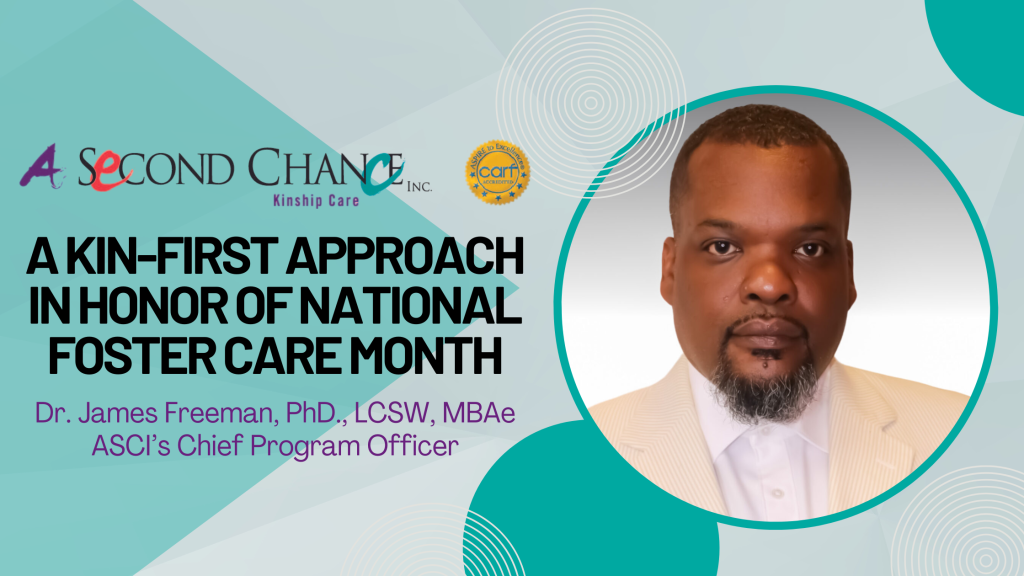
For Dr. James Freeman, Chief Program Officer at ASCI, this truth is professional and deeply personal. His perspective reflects what National Foster Care Month uplifts nationally: the urgent need to center family-based care as the foundation of child welfare practice. His leadership is grounded in decades of experience and a lifetime of witnessing the impact of kinship care firsthand. He speaks not in theory, but from lived reality, where family stepped in, stability was preserved, and futures were protected.
Kids do better with families. Centering kinship care means centering a child’s stability and their connection to who they are.
Dr. James Freeman
Kinship care preserves more than just a living arrangement. It protects a child’s sense of self, their family traditions, and their connection to the people and experiences that shape who they are. It allows children to remain connected to their roots, their traditions, and the people who know them best. In moments of disruption, that continuity can be the difference between fear and familiarity, between isolation and support. During National Foster Care Month, this truth is amplified as systems nationwide examine how to reduce disruption and strengthen family continuity.

Dr. Freeman highlights the strength and resilience that emerge when children remain connected to family. Familiar spaces, routines, and relationships help foster a sense of trust, stability, and continuity for children during times of transition. At ASCI, we believe kinship care strengthens that foundation by keeping children connected to the people, relationships, and communities that already know and love them, creating spaces where care is rooted in trust and connection.
Kinship care gives families the opportunity to protect their own and keep their family intact.
Dr. James Freeman
That philosophy is embedded in ASCI’s model. From the moment a child is identified for placement, the organization moves quickly to support kinship caregivers. Families are not expected to navigate this transition alone or wait for resources. Immediate, tangible support, such as financial assistance, clothing, or food, is provided so that caregivers can focus on what matters most: the child’s well-being. This responsiveness reflects a priority to ensure timely, equitable support for families stepping into caregiving roles.

This responsiveness reflects a deeper understanding that kinship caregivers are often called to step into life-changing roles with little warning but with unwavering love. ASCI recognizes that they are doing far more than providing temporary care. They are offering stability in moments of uncertainty, nurturing a child’s emotional well-being, and helping shape a future grounded in trust, connection, and belonging.
Families don’t just need to be available. They need to be supported.
Dr. James Freeman
For Dr. Freeman, the power of kinship care is best illustrated through his own family’s journey. When his sister struggled, their mother stepped in to care for her five children. Over time, with the support of family and community, those children were reunified with their mother and have gone on to lead successful, stable lives. It is a story not of perfection, but of resilience, healing, and the enduring strength of family.
That same legacy continues into the next generation. After a tragic loss in his family, a young child was raised by a relative through kinship care and grew into a thriving adult, serving in the military and building a life of his own. These are reflections of what is possible when children remain connected to family.
Kinship care is not just what I do. It’s what raised me. It’s what saved my family.
Dr. James Freeman
Despite its proven impact, misconceptions about kinship care persist. One of the most common is the belief that challenges within a family automatically disqualify relatives from providing safe, supportive care. Dr. Freeman challenges this notion directly, pointing out that families are complex and that, as ASCI recognizes, within that complexity are individuals who are more than capable of stepping up to provide children with love, stability, and a strong sense of belonging.
Just because there are challenges in a family doesn’t mean there isn’t someone who can be a strong, safe resource.
Dr. James Freeman
ASCI doesn’t make assumptions but focuses instead on understanding, strengthening, and building alongside the families it serves. This work extends beyond individual caregivers to the entire family network, recognizing that shared strengths, clarifying roles, and connecting to the right supports promotes lasting stability. Permanency is an intentional, ongoing conversation that begins on day one.
This holistic, kin-first approach is especially critical in today’s landscape, where young people face increasing social and emotional challenges. During National Foster Care Month, ASCI recognizes the importance of strengthening family-based responses that preserve connection, stability, and belonging for children and youth. For kinship caregivers, supporting young people means drawing on immense strength, patience, and commitment to guide them through adolescence while offering steady care, reassurance, and meaningful connection during times of transition and change.

Despite its proven impact, misconceptions about kinship care persist. One of the most common is the belief that challenges within a family automatically disqualify relatives from providing safe, supportive care. Dr. Freeman challenges this notion directly, pointing out that families are complex and that, as ASCI recognizes, within that complexity are individuals who are more than capable of stepping up to provide children with love, stability, and a strong sense of belonging.
Just because there are challenges in a family doesn’t mean there isn’t someone who can be a strong, safe resource.
Dr. James Freeman
ASCI doesn’t make assumptions but focuses instead on understanding, strengthening, and building alongside the families it serves. This work extends beyond individual caregivers to the entire family network, recognizing that shared strengths, clarifying roles, and connecting to the right supports promotes lasting stability. Permanency is an intentional, ongoing conversation that begins on day one.
This holistic, kin-first approach is especially critical in today’s landscape, where young people face increasing social and emotional challenges. During National Foster Care Month, ASCI recognizes the importance of strengthening family-based responses that preserve connection, stability, and belonging for children and youth. For kinship caregivers, supporting young people means drawing on immense strength, patience, and commitment to guide them through adolescence while offering steady care, reassurance, and meaningful connection during times of transition and change.
Centering kinship allows a child to stay connected, maintain their bonds, and remain rooted in their family and community.
Dr. James Freeman

That reality makes the role of kinship caregivers even more vital and underscores the need for systems and communities to better identify, engage, and support them early. It also highlights the importance of shifting public understanding, as ASCI knows that while many people instinctively value family, fewer fully understand the depth of commitment, sacrifice, and support required to sustain successful kinship placements. During National Foster Care Month, these caregivers deserve recognition as essential partners in creating positive, lasting outcomes for children and families.
As Dr. Freeman reflects on the broader significance of this work, he points to its roots in longstanding cultural traditions. Kinship care is not a new concept, it is a practice deeply embedded in communities, particularly within African and African American traditions, where caring for one another has always been a shared responsibility.
Kinship care is not new. Families have always taken care of families. Now, we have the opportunity to support that with resources and policy.
Dr. James Freeman
During National Foster Care Month, that message carries urgency. When systems invest in kinship care through funding, policy, and practice, they are not just improving outcomes; they are honoring a model that has always worked. They are ensuring that more children can grow up with stability, graduate, avoid further system involvement, and step into adulthood with a strong foundation.
At ASCI, this work is not abstract. It is happening every day, across communities, touching hundreds of children and families. It is seen in the quiet moments of reassurance, the immediate response to a family in need, and the long-term successes of young people who were given the chance to stay connected to who they are.
At our core, A Second Chance, Inc. is driven by a belief that continues to prove true: when we keep children connected to family, we give them the best possible chance to thrive.