Blog
Kinship Keeps Families Connected. Are Systems Keeping Up?
The NKR Brief | National Kinship Review
How kinship care preserves family connection and what research tells us about building systems that better support kinship families.
Family has always been one of society’s first and most enduring sources of care.
Long before there were programs, policies or professional terminology to describe it, grandparents raised grandchildren. Aunts and uncles stepped in. Older siblings cared for younger ones. Extended family and trusted members of communities surrounded children and parents alike, sharing in the responsibility of caring for and supporting the family.
Kinship care gives language to this longstanding tradition of families caring for their own. Across the country, its value is receiving greater recognition in child welfare policy, practice and systems reform. But as the field moves toward more kin-first approaches, an important question remains: Is that progress translating into how children and families experience support?
For National Kinship Care Month, the National Kinship Review spoke with nationally renowned kinship expert Dr. Joseph Crumbley and Robert Matthews, chief program officer at Think of Us. Their perspectives, considered alongside research on kinship care, point toward a broader understanding of what it means to be kin-first.

It begins with recognizing what family connection can preserve. But it also requires listening to those closest to the experience, understanding what the evidence tells us and building systems that respond to the realities of kinship families.
Connection, belonging and the power of family
For Crumbley, the power of kinship begins with what can be preserved when a child remains connected to family.
Separation from parents is a traumatic experience for children, often bringing significant changes to their daily lives. Kinship care can help minimize further disruption by keeping children connected to family, familiar relationships and a shared history. Crumbley says those existing connections can provide a foundation for trust and attachment, helping children begin the healing that comes from separation, trauma and disruption.
That connection also carries history. Children may already share memories, relationships, culture and identity with the person stepping into a caregiving role. Unlike a relationship that begins only after a child experiences disruption, kinship may offer something that already existed.
“In kinship care, you have the memories,” Crumbley said. “The fact is, we share history.”
That history can reinforce a child’s sense of identity and belonging during a period when much else may be changing.
It can also create an opportunity for families to write a different chapter together.
Drawing on decades of work as a family therapist, Crumbley cautions against assuming that challenges within one part of a family define the entire family network. That way of thinking, he suggests, can overlook the ability of other relatives to provide safety, stability and a different model of family relationships.
Family connection carries tremendous value, and preserving those relationships can be an important source of belonging, identity and healing. At the same time, a family-centered approach listens to children and young people, considers their individual experiences and recognizes that every relationship within a family may be different. Challenges within one relationship should not lead systems to overlook the strength, safety and connection that may exist throughout the broader family network.
For Crumbley, that is where kinship’s potential becomes especially powerful.
“The power of family is that they can break cycles, interrupt cycles and create new legacies.”
Dr. Joseph Crumbley
That potential is not rooted in family connection alone, but in what caregivers can build from it. Shared history can provide a starting point, while consistency, care and different patterns of caregiving can help children develop or rebuild trust. In that way, kinship caregivers have an opportunity not only to preserve important family relationships, but to demonstrate what those relationships can become.
ASCI’s own kinship model is grounded in a similar value for family. Its approach emphasizes natural supports, cultural identity and the entire kinship triad of child, caregiver and birth family, with family connectivity treated as integral to the work rather than incidental to it.
Matthews expands the definition of connection even further.
After more than 25 years working in kinship care, he said hesitation about placing children with family can still persist, despite the growing body of research supporting kin-first approaches. Yet what is at stake extends beyond the relationship between a child and caregiver. Children are connected to entire networks of people, places and relationships that help create familiarity, belonging and continuity.
“They’re connected to the schools that they continue to go to. That means that they’re connected to friends that they have. They’re connected to the different communities, to the church that they go to.”
“They’re connected to the schools that they continue to go to. That means that they’re connected to friends that they have. They’re connected to the different communities, to the church that they go to.”
Robert Matthews
When those connections are disrupted, children can lose far more than a familiar home. Matthews cautions that this disruption can show up in a child’s behavior and well-being, even when systems may be tempted to view those responses in isolation. His point is not that every family relationship is automatically the right one, but that the full network surrounding a child deserves careful consideration.
A kin-first approach, then, is not simply about identifying a relative. It is about understanding the relationships that matter to a child, preserving connection where possible and continuing to ask who within that broader network can provide safety, stability and support.
What the research shows
The growing emphasis on kin-first practice is not based on sentiment alone. A substantial body of research has examined what happens when children who cannot safely remain with their parents are cared for by relatives or other kin. While no family arrangement guarantees a particular outcome, the evidence consistently points to important benefits associated with maintaining family and community connections.
Research consistently points to the role kinship can play in creating greater stability for children. Casey Family Programs finds that children initially placed with relatives are less likely to experience placement changes.
ASCI’s own evidence adds to that picture: a 2024 evaluation of its Point-of-Contact model found lower rates of re-entry and placement disruption compared with children served outside the model. The findings reinforce the importance of identifying and supporting family early, an approach Dr. Sharon McDaniel has also explored through her Think of Us master class, Making the First Placement the Final Placement.
The evidence also points beyond stability alone. Recent findings from Child Trends associate kinship care with stronger family and cultural connections, better behavioral and mental health outcomes, greater placement stability and less disruption for children. A separate Child Trends study found that children in both formal and informal kinship care fared better academically than children in non-relative care, particularly in math.
Those outcomes are shaped by more than the caregiving arrangement itself. Casey Family Programs also points to the importance of sibling relationships, caregiver-child relationships and broader social support networks in promoting stability. Together, these findings underscore the value of preserving the relationships and communities that surround children.
The research reinforces something kinship families have demonstrated for generations: Connection is not simply about where a child lives. It can shape continuity, identity, relationships and well-being.
But the evidence also carries an important implication for the field. Placing a child with kin is not, by itself, enough. Caregivers need resources and support to sustain the family connections systems are working to preserve. In other words, recognizing kin matters. Supporting kin matters, too.
From listening to influence
That distinction between recognizing families and meaningfully supporting them extends to how systems engage people with lived experience.
Matthews sees this firsthand through Think of Us’ California KIN Accelerator Pilot, which is working with eight California counties to strengthen kin-first culture and practice.
The work begins by listening to caregivers and people closest to the issues being addressed. But Matthews is clear that listening cannot be the end of the process.
“It’s not just bringing lived experience to the table to talk about their story,” he said.
Meaningful engagement, he explained, involves people with lived experience throughout the work. They can serve as thought partners, advisers and contributors to implementation and accountability. Just as importantly, organizations need to be clear about what role a person actually holds and how much influence comes with it.
For Matthews, meaningful participation also requires attention to the practical conditions that make engagement possible, an approach reflected in Think of Us’ work with lived experts. People may need preparation before meetings, transportation or child care, and their time and expertise should be valued. Think of Us works to provide that support while establishing clear expectations from the outset so lived experts understand their role and are equipped to participate meaningfully.
Matthews’ point moves the conversation beyond whether lived experience is “at the table.”
The more important question is: What happens because they were there?
For systems seeking to become more responsive to families, that is an important distinction. Family voice should not simply document what has already happened. It should help influence what happens next, Matthews posits.
ASCI’s Family Group Decision-Making model reflects a similar value for family voice and shared decision-making. The approach recognizes families as experts in the planning process and creates space for them to identify their strengths, concerns and resources while helping shape the plans intended to support their children and families.
Kin-first is more than a placement decision
As kinship has gained greater attention, so has the language of becoming “kin-first.”
But Matthews argues that kin-first practice cannot begin and end with one question at the moment a child needs care: Did we look for relatives?
Through the KIN Accelerator, counties are examining kinship across a continuum. That can mean looking at whether kin were identified early, whether siblings remain connected, whether family relationships are revisited as circumstances change and whether children moved through other settings before available kinship connections were fully explored.
Viewed this way, kin-first becomes less about a single decision and more about how systems understand family throughout a child’s experience.
Crumbley sees a parallel shift in how the field understands kinship families themselves. He remembers when kinship was more likely to be viewed as temporary or secondary to other family arrangements.
“People are now starting to realize that [kinship families] are the mainstream family,” he said.
“People are now starting to realize that [kinship families] are the mainstream family.”
Dr. Joseph Crumbley
That recognition should shape practice.
If kinship is understood as a fundamental way families have always cared for their own, systems must be designed to recognize family networks early, preserve meaningful connections and provide caregivers with the support necessary to sustain them.
ASCI has explored these same connections in its own work, examining how a kin-first culture can help preserve family relationships, sibling connections, cultural identity and ties to community.
The informal kinship gap
The implications become especially significant when the conversation turns to families caring for children outside formal child welfare involvement.
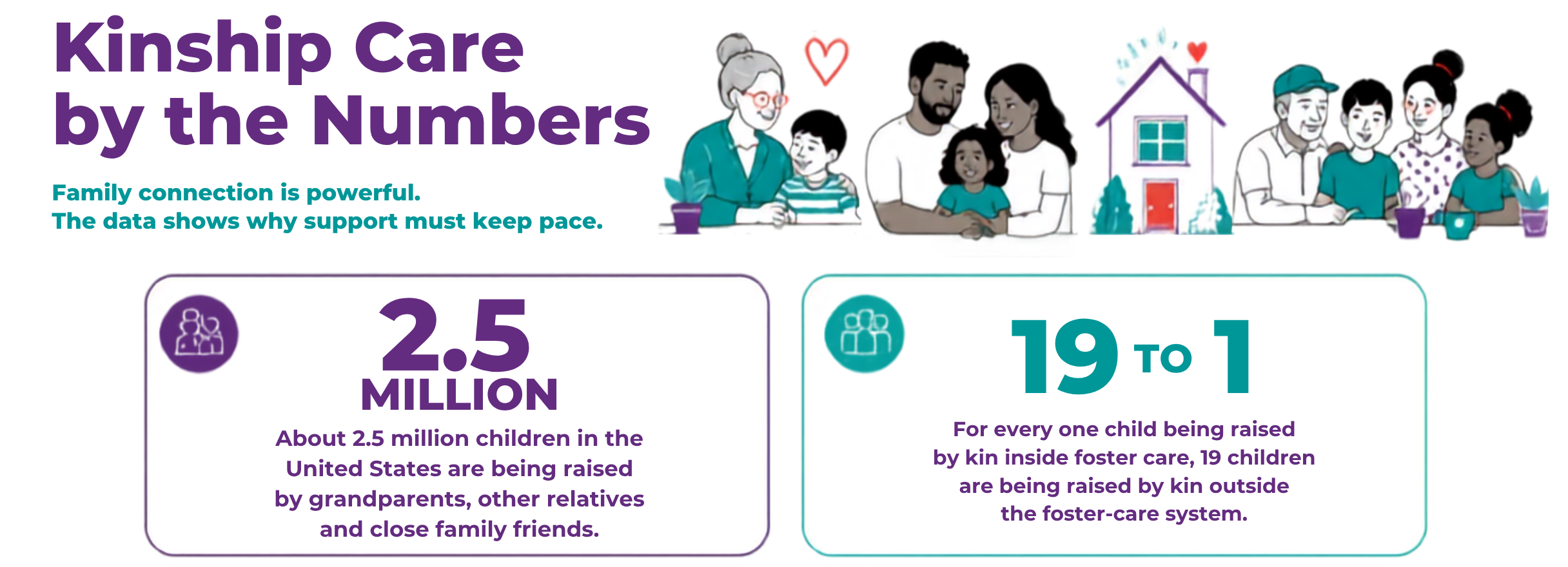
National data illustrate the scale. According to the Grandfamilies & Kinship Support Network, for every one child being raised by relatives within the foster care system, 19 are being raised by kin outside of it. The organization estimates that about 2.5 million children nationally are being raised by grandparents, other relatives or close family friends.
That means much of kinship caregiving is happening beyond the formal structures most often associated with child welfare.
Families step in because a child needs them. Yet informal caregivers may encounter difficulties obtaining financial assistance, establishing legal authority, enrolling children in school, accessing health care or simply determining what resources are available.
ASCI recently explored these distinctions in its caregiver resource, Informal vs. Formal Kinship Care: What You Need to Know, which outlines some of the legal, financial and administrative differences families may encounter.
Both the scale of informal caregiving and the barriers these families can face raise a larger question for the field: How do we support kinship families that may never enter the systems where kinship services have traditionally been concentrated?
Crumbley sees an opportunity for institutions already interacting with families, including schools, health care providers and community organizations, to become better at recognizing kinship caregivers and connecting them to support.
One way to do that, he suggested, is through simple screening questions built into the places families already encounter. A question such as, “Are you raising a child in your family who is not your birth child?” could help identify caregivers earlier and connect them proactively to kinship resources and services before a crisis occurs.
Crumbley’s point is not simply about identification. It is about changing when support becomes available. Families should not have to reach a breaking point before systems recognize the work they are already doing.
Matthews similarly pointed to informal kinship as an area where more attention is needed, even as policies and supports improve for families connected to formal systems. He said the field also needs a “philosophical understanding” of what kinship is and is not, grounded in research and a broader view of family connection.
The next stage of kin-first practice may therefore require looking beyond child welfare alone. If millions of children are being cared for by kin, supporting those families becomes a community responsibility as much as a child welfare one.
What this means for the field
The direction of the evidence and the experiences of families point toward an important evolution in kinship practice. The question is no longer simply whether family should be considered.
The deeper questions are whether systems recognize the full value of family connection, whether caregivers receive meaningful support, whether children and families have influence in decisions that affect them and whether help can reach families before crisis makes them visible.
Taken together, the evidence and experiences point to four key implications for the field:
- Connection should be treated as an outcome worth protecting. Safety remains essential, but stability, belonging, cultural identity, sibling relationships and community ties should also inform how decisions are made.
- Lived experience should influence design and implementation, not merely inform discussion. Listening is necessary. Sharing power requires going further.
- Kin-first practice should extend across the continuum. Finding family is important, but so is maintaining connections, revisiting family networks and ensuring caregivers have the support to sustain those relationships.
- Prevention requires earlier support. Families should not have to reach crisis before the systems and communities around them recognize what they need.
Crumbley described both tangible supports, such as food, clothing, housing, financial resources and health care, and the less visible supports families may need as roles and relationships change. Matthews similarly connected the future of kinship to prevention and the resources necessary to keep families together.
That is where recognition must become action.
For more than three decades, ASCI has built its kinship practice around the belief that family is a resource and that supporting the entire kinship family strengthens safety, stability and well-being. Its work reflects a broader principle increasingly visible across the field: A value for family has to be expressed not only in where children live, but in how policies, practices and resources respond to the families caring for them.
National Kinship Care Month is an opportunity to celebrate the grandparents, relatives, close family friends and extended networks who show up for children every day, and to ask what comes next.
Families have been doing the work of kinship for generations. The next measure of progress will be whether the systems and communities surrounding them are willing to build around that reality, ensuring connection is not only preserved, but supported.
Newsletter Signup
Stay on top of ASCI news and events by signing up for our newsletter!